Case
Miniaturizing Fiber-Optic Sensing: From Rack-Mount to ASIC-Ready Module
Reducing size and BOM cost by factor 50 through strategic mixed-signal integration.
.jpg)
Fiber-optic sensing offers unmatched precision for aerospace and medical applications, but traditional interrogators are prohibitive in size (often 19-inch racks) and cost (€10k–€50k). To enable high-volume application in catheters and structural monitoring, Technobis faced a critical hardware challenge: drastic miniaturization without compromising the signal-to-noise ratio. Bruco IC engineered the electronics to shrink this complex system into a "MonadGator" module—the size of a memory stick.
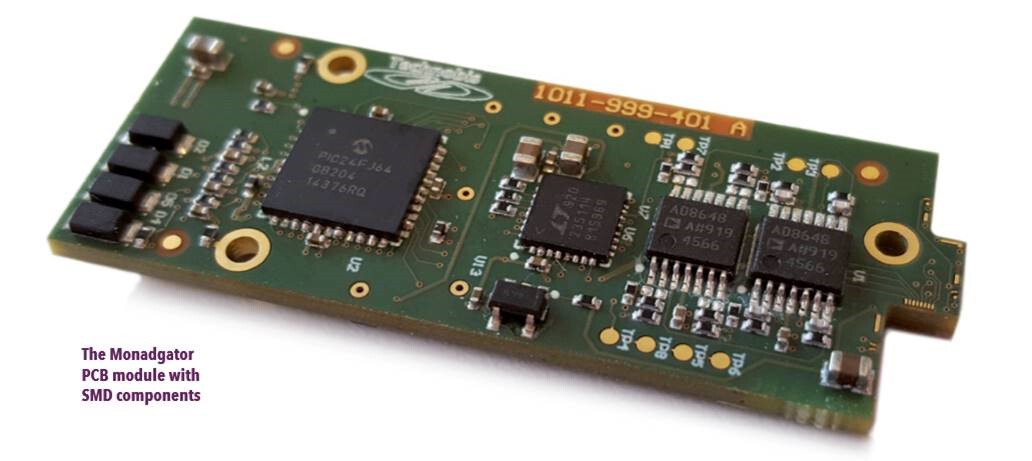
Technobis utilizes an Application Specific Photonic Integrated Circuit (ASPIC) based on Indium Phosphide to measure strain, shape, and temperature via optical fibers. The readout electronics for this ASPIC traditionally required substantial physical space and power.
The objective was aggressive: reduce the form factor from a shoebox/rack size to a handheld device (Gen 3A) and ultimately a single ASIC (Gen 3B) to make the technology viable for disposable medical endoscopes and widespread industrial IoT.
The miniaturization of this FBG (Fiber Bragg Grating) interrogator technology opens up critical applications where standard electronic sensors fail due to size, weight, or electromagnetic interference (EMI):
Moving directly from a rack-mounted system to a custom ASIC involves significant risk and lead time. We mitigated this by developing "Gen 3A" first—a highly optimized implementation using discrete components that mimics the future ASIC architecture.
The current module achieves a 5x reduction in Bill of Materials (BOM) cost. The next phase, currently in architecture planning, integrates the TIA, ADC, and driver stages into a custom Mixed-Signal ASIC. This integration is projected to reduce the BOM by a factor of 50 compared to the original system, unlocking high-volume markets.
Download the article here

Explore the latest developments in RF IC, analog/mixed-signal design from Bruco Integrated Circuits.


.png)