Case
Wideband Ku-Band Phased Array: True-Time Delay ASIC Design
Achieving constant group delay across 2 GHz bandwidth required a SiGe BiCMOS architecture using programmable True-Time Delays.
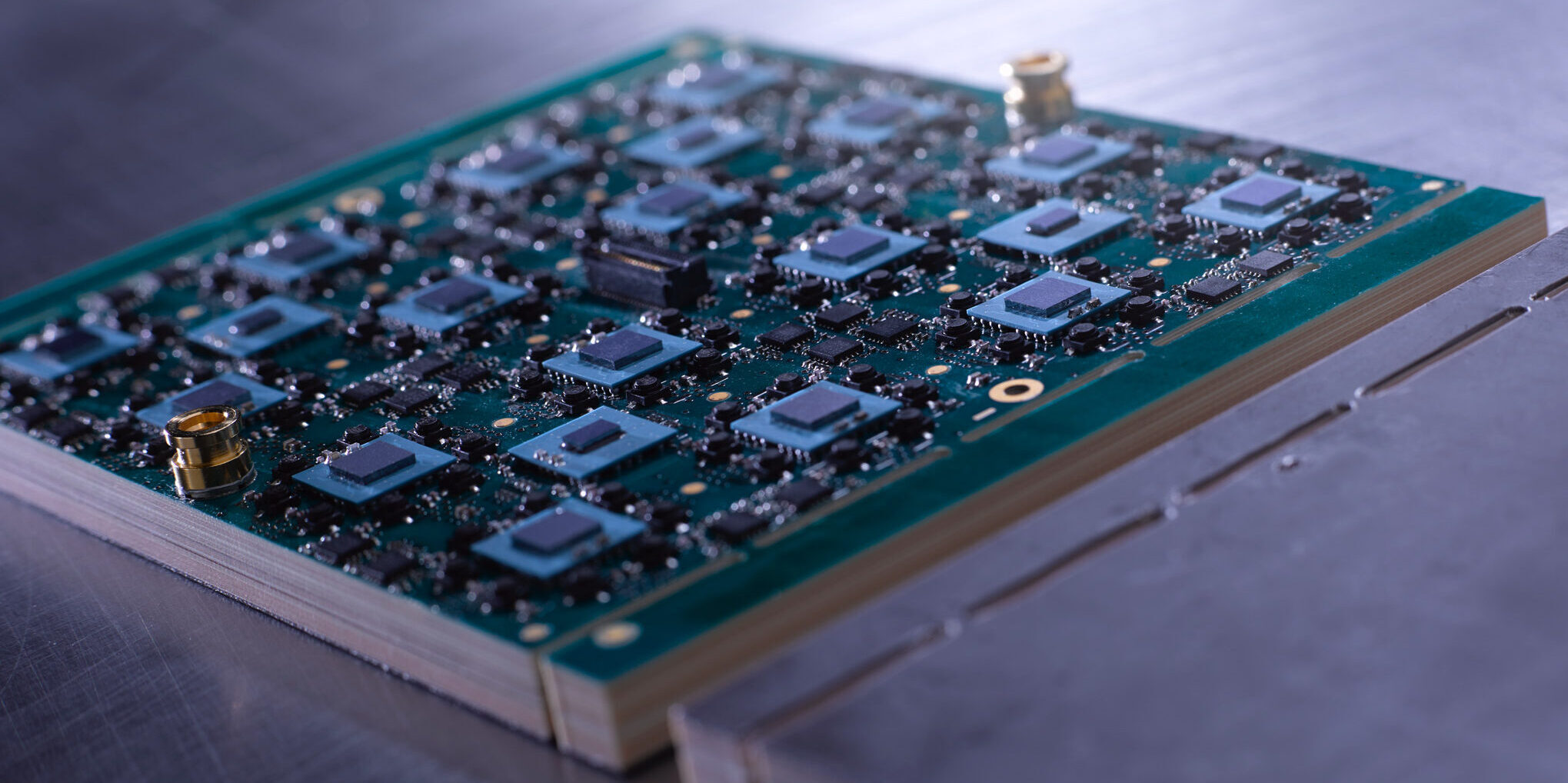
Mobile satellite communications require low-profile antenna systems capable of tracking geostationary satellites from moving platforms. The engineering constraint was receiving the full Ku-band (10.7 – 12.75 GHz) instantaneously. Standard phase shifting approaches fail over this 2 GHz bandwidth due to frequency-dependent group delay errors (beam squint). We engineered a modular phased array system based on 0.25 µm SiGe BiCMOS ASICs that utilizes True-Time Delay (TTD) cells to ensure constant group delay and accurate polarization handling.

The project required a phased array receiver capable of handling the full Ku-band spectrum simultaneously. The primary technical obstacle was maintaining a constant group delay across the entire 2 GHz bandwidth while achieving a total system Noise Figure (NF) of 0.7 dB.
Ideally, the ASICs required a Noise Figure of approximately 2 dB to meet the system budget. Additionally, because the antenna mounts on moving objects (aircraft, vessels), the polarization of incoming signals shifts arbitrarily relative to the antenna. The system needed to resolve orthogonal X and Y components and translate them back into Vertical (V) and Horizontal (H) polarization in the analog domain before digitization. All electronics for a 64-element subarray had to fit within a 10x10 cm footprint.
In narrow-band applications, phase shifters suffice for beam steering. However, over a 2 GHz instantaneous bandwidth, phase shifters introduce significant beam squint because they provide a constant phase shift rather than a constant time delay.
To eliminate this error, we prioritized signal fidelity over circuit simplicity by implementing programmable True-Time Delays (TTD). TTD circuits provide a delay that is physically consistent across all frequencies in the band, ensuring frequency-independent beam steering.
We selected the NXP QUBiC4Xi 0.25 µm SiGe BiCMOS process for this design. The high transit frequency (fT ≈ 180 GHz) of the SiGe heterojunction bipolar transistors (HBTs) was necessary to meet the stringent noise and gain requirements at Ku-band frequencies.
The system architecture relies on a hierarchical ASIC approach to manage signal combination and routing:
The physical implementation involved a high-density 15-layer RF PCB. This board integrates the patch antenna array, RF routing, and the ASIC chipset on the reverse side.
This architecture was validated in hardware. The modular tile design successfully demonstrated the ability to receive both vertical and horizontal polarizations across the full bandwidth with the required group delay consistency.
This engineering work was realized within the Satrax consortium, a Dutch government-subsidized program. Technical partners included NLR, University of Twente, VPS, LioniX, PhoeniX, and Astron.
Explore the latest developments in RF IC, analog/mixed-signal design from Bruco Integrated Circuits.


.png)